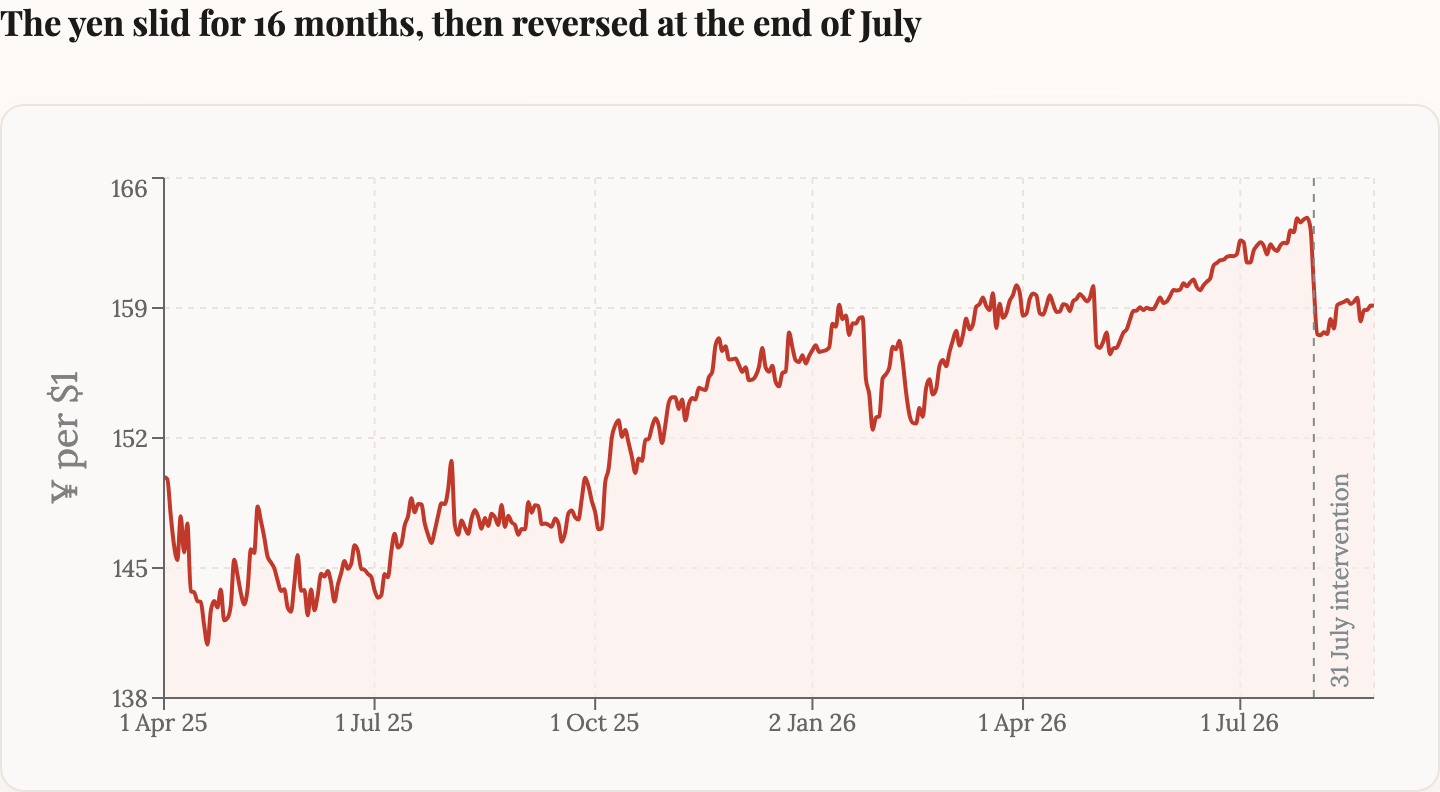
Japan's currency is in trouble. From April 2025 to July 2026 the yen fell from $1 = ¥141 to $1 = ¥164.1 Japan spent $71 billion on imports including food, oil and other essential goods in June 2026 alone.2 The fall in the yen makes it more expensive for the Japanese to import these goods, leading them to have to exchange more of their own currency to obtain them. So why did the U.S. intervene? This article will delve deeper into why the U.S. wanted to save the Japanese yen.
Context: Inflation Pressure
Over the past five years, Japan's economy has shifted. Inflation was not really prevalent within the Japanese economy pre-Russia-Ukraine war, with its rate constantly below 2%. After the invasion, upward pressure on commodity markets such as oil and gas led to record levels of inflation at 4.3% in January 2023. Following this, the economy saw some of its highest inflation rates, hovering between 3% and 4.3% in the period 2023 to 2025. Since then, the inflation rate has dropped between 1% and 2%, bringing some stability within the economy. A higher inflation rate, however, leads to real interest rates falling, so the value of the interest gained is lower. This leads to fewer investors wanting to save money in Japanese banks and move to countries with higher interest rates and lower inflation to maximise interest potential.
The Interest Rate Divide: Why Investors Looked Beyond Japan
Japan is well-known for its extremely low interest rates, which is a key principle within the Japanese financial system. Pre-2024, the interest rate was -0.1%. This comes after its prolonged period of economic stagnation and deflation (Japanification) in the early 1990s to entice borrowing and accelerate growth after its 'lost decade'. However, this leads to lower rewards for yen-denominated assets. If foreign assets, particularly U.S. assets, offer higher returns, investors may shift their attention away from lower-yielding Japanese assets and allocate more capital towards the United States. This can be illustrated through the yen carry trade, whereby investors borrow cheaply in yen due to Japan's relatively low interest rates and invest the funds in higher-yielding U.S. assets such as bonds. As investors sell yen to purchase dollars and dollar-denominated assets, this can place further downward pressure on the value of the yen. This led to Japan increasing its rates to a 31-year high of 1%.5 Whilst this is a significant increase in interest rates for Japanese financial intermediaries, it is still significantly lower than its counterparts such as the U.S. with 3.75%, the UK also 3.75% and Australia with 4.35%.
U.S. Intervention: What Happened?
The Ministry of Finance, seeing the yen-dollar exchange rate plummeting, began selling dollars to buy yen on 30th July, with the Bank of Japan acting as its agent in the market. Goldman Sachs estimated the operation amounted to up to $85 billion across 30th and 31st July, roughly $60 billion on the Thursday and $25 billion on the Friday, against average daily trading volume of about $30 billion.6 The U.S. Treasury joined on 31st July. Its contribution has not been disclosed, but Goldman noted that U.S. participation in past coordinated interventions has typically run at only $1 billion to $2 billion, making the American leg far smaller than Japan's and largely a signal of support. It was the first joint U.S.-Japan operation to buy yen since 1998. The yen strengthened from $1 = ¥164 to below $1 = ¥158, though part of that move was given back over the following fortnight.
Why the U.S. intervened
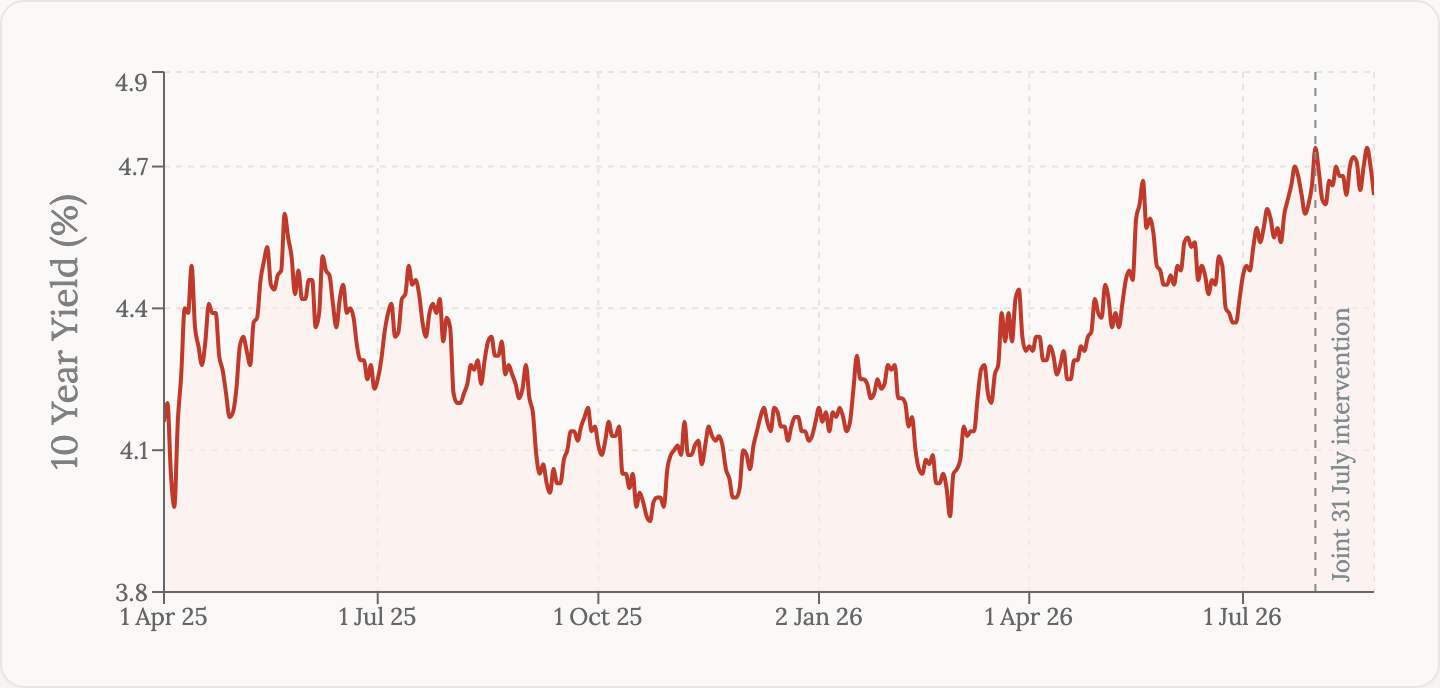
Firstly, and probably the most important, Japan is the largest foreign holder of U.S. Treasury bonds at around $1.2 trillion.7 To prevent the value of the yen from spiralling, they would have to sell a large proportion of their high-value assets, mainly the bonds which they would sell to then put the cash into the FX market. This would have been an issue for the U.S. bond market as when a lot of supply is put onto the market and the price goes down, the yield of the bonds increases, meaning the U.S government would pay more to the holders of the bonds. This is especially a problem as the U.S. already has high bond yields meaning that they would pay significantly more to bondholders, which would put pressure on government finances and may lead to increased borrowing.
Japan's enormous government debt also makes the conventional response to a weakening currency more difficult. Normally, a central bank could raise interest rates to make domestic assets more attractive and support the currency. However, with Japan's government debt standing at an exceptionally high level, substantially higher interest rates would increase the government's debt-servicing costs and place greater pressure on public finances. This leaves Japanese policymakers with less room to use aggressive interest-rate rises to defend the yen, making foreign-exchange intervention and external support relatively more important.
Rather than forcing Japan to sell large quantities of US Treasuries to raise dollars for intervention, the Federal Reserve's FIMA repo facility can provide dollar liquidity against those Treasury holdings. This reduces the potential for intervention to create disorderly selling in the US Treasury market.6
There may also have been a broader strategic reason for U.S. involvement, such as preventing instability in Japan from spreading through Asian and global financial markets. Japan is not an isolated economy; it is deeply integrated into the financial system through trade, investment and capital flows across Asia. A sharp and disorderly fall in the yen could therefore create problems far beyond Japan. If Japanese investors and financial institutions began rapidly reducing their exposure to foreign assets, or if instability caused investors to become more risk-averse, markets across Southeast Asia could come under pressure. The effects could eventually reach Wall Street. American financial institutions and investors have significant exposure to Asian economies through equities, bonds, funds and multinational companies operating in the region. A major shock in Japan could therefore trigger a wider sell-off in Asian assets, weakening investor confidence and increasing volatility in global markets. Even the performance of major indices such as the Nikkei 225 matters to global investors because it acts as an important indicator of the health of the world's fourth-largest economy.
Financial contagion: The spread of financial instability from one country or market to others through interconnected trade, investment and financial markets.
What this means
When China manages its exchange rate, it is accused of breaking free-market rules; when Washington steps in to support the yen, it is lauded as a good ally. Yet behind the geopolitical diplomacy lies cold economic logic. Tokyo needed help, but Washington only gave it because letting the yen sink posed a direct threat to American stability. Ultimately, this was never a rescue mission; it was a pre-emptive strike against contagion. If allied interventions are driven purely by national self-interest, how long can the U.S. global financial leadership truly last?
Footnotes
-
Yahoo Finance, USD/JPY (JPY=X) historical data (opens in a new tab), 26th August 2026. 2
-
Trading Economics, Japan Imports (opens in a new tab), 2026.
-
Statistics Bureau of Japan, Consumer Price Index: Japan 2025 (opens in a new tab), 23rd January 2026; Statistics Bureau of Japan, Consumer Price Index (opens in a new tab), 2026.
-
Bank of Japan, Change in the Guideline for Money Market Operations (opens in a new tab), 16th June 2026.
-
BBC, Japan raises interest rate to highest for 31 years (opens in a new tab), 16th June 2026.
-
Goldman Sachs, What the US-Japan Currency Intervention Means for the Yen, Rates, and the Dollar (opens in a new tab), 10th August 2026. 2
-
Reuters, Foreign holdings of US Treasuries fall in June, led by Japan, UK, China, data shows (opens in a new tab), 17th August 2026.
-
Yahoo Finance, CBOE Interest Rate 10 Year T Note (^TNX) historical data (opens in a new tab), 26th August 2026.