
For an entire generation, the European military-industrial complex was a sleeping giant. Cocooned in the post Cold War illusion of permanent peace, defence budgets shrank, supply chains rusted and the market was fiercely guarded by a handful of proprietary, nationalistic monopolies.
But now faced with existential geopolitical threats and a rapidly shifting technological landscape, the ‘black box’ monopolies are fracturing, being replaced by a ruthless demand for standardised warfare. But governments aren’t rebuilding this arsenal alone. With diminishing market cyclicity and unprecedented multi-year budgets locked in, private equity is quietly stepping out of the shadows to finance the new machinery of European survival.
The Kamikaze Correction
Nowhere is this sudden influx of capital more visible than in the maritime sector. The catalyst? The waters of the Black Sea. When Ukraine deployed its relatively cheap, kamikaze-style Magura V5 sea drones to systematically neutralise modern Russian warships, it sent a shockwave through global military commands. It was a definitive wake-up call; The era of maritime dominance by multi-billion-dollar warships is facing a severe threat from autonomous, agile technology.
Now, navies and defence companies are scrambling to adapt. This panic has triggered a massive influx of capital into specialised maritime defence platforms, turning the sector into a modern gold rush. In just one month, we watched industry giants make aggressive moves:
-
Thales acquired a controlling stake in sea-drone maker Exail for €3.9 billion.1
-
Fincantieri dropped €600 million into acquiring 4 underwater defence companies.2
-
Lockheed Martin scooped up Ultra Maritime for a whopping $3.45 billion.3
But this sudden consolidation is about more than just matching firepower. The oceans are the lifeblood of the modern economy. They safeguard everything from critical global trade corridors to undersea telecommunications. With these vital assets increasingly at risk, maritime defence has never been more important. And private equity is reaping massive rewards from this. Take Advent International. After injecting $170 million into Ultra Maritime’s engineering and product pipelines over three years, they engineered the perfect, highly lucrative exit.3
Key figures: Amount injected: $170 million · Investment duration: 3 years · Acquisition value: $3.45 billion
Ultimately though, this wave of acquisitions represents far more than a few isolated market events. It is the physical manifestation of a structural transition.The ocean is simply the most visible testing ground for a structural pivot that is consuming the entire defence sector. As the geopolitical temperature rises, the West is quietly and rapidly outsourcing the industrial scale-up of its global defence capabilities to the private market.
The new Holy Grail
For years, the European defence market was volatile. In 2014, only three NATO countries (US, UK, Greece) actually hit their 2% defence spending targets. But following the 2022 invasion of Ukraine, that 2% request morphed into a strict mandate. Today, nearly all 27 member states are locked in, driving EU defence spending to a record-breaking €381 billion in 2025.4
Now, NATO is eyeing an even more ambitious target: 5% of GDP by 2035 (3.5% for traditional defence and 1.5% carved out specifically for cybersecurity, drones and intelligence).4 For PE firms, this is the holy grail. This massive influx of government capital generates multi-year contracts and deep backlogs that completely strip away market cyclicity. It creates a guaranteed, public revenue floor which is the exact low-risk environment to aggressively deploy LBO frameworks across defence sub-tiers.
This flood of capital is already shifting the geopolitical landscape. Airbus and MTU Aero Engines are teaming up to build a zero-emission hydrogen fuel-cell propulsion system that emits only water vapour, marking Airbus’s deepest venture yet into engine development. As relations with the US fray, Canada is pivoting to Europe, tapping Germany’s TKMS to build 12 Type 212CD submarines — diesel-electric boats with air-independent hydrogen fuel-cell propulsion and ~2,800-tonne submerged displacement, purpose-built for Arctic operations. Furthermore, at the Ankara NATO summit, Germany secured US approval to purchase American-made Tomahawk cruise missiles and Typhon launchers for stationing on German soil — a strategic procurement designed to thaw tensions between Washington and Berlin.5
As governments lock in massive, multi-year spending mandates, they aren’t just buying submarines and missiles, they are effectively underwriting the golden age of defence private equity.
A paper thin shield
It is difficult to fully grasp this massive financial shift without looking at the strategic post-mortem that caused it. What remains is the brief, brutal history of how Europe lost its military edge and why it is now paying billions to buy it back.
For two decades following the Cold War, Europe coasted on a dangerous illusion, that major conflicts were behind them. In that era of complacency, the bloc let its military supply chains rust, content to simply outsource its continental security to Washington.
Then reality hit.
The 2014 Russian annexation of Crimea shattered the illusion of perpetual peace, triggering NATO’s initial 2% defence spending pledge. The 2022 full-scale march on Kyiv however, truly exposed the bloc’s vulnerabilities. It forced a chilling realisation: if a close European ally could be invaded, what was stopping Russia from invading other NATO countries? Overnight, it effectively exposed NATO’s reliance on the US and proved that modern borders are no longer guaranteed.
Simultaneously, the geopolitical map began shifting. Donald Trump’s infamous bid to buy Greenland was a preemptive strike in the new Arctic race. As the northern ice thaws, the region has rapidly transformed into a geopolitical chokepoint, triggering a ruthless scramble to control the Pituffik early warning systems, dominate rare earth supply chains and secure the Polar Silk Route. However, and perhaps for the first time, the EU pushed back. Eight European nations deployed troops to Greenland under Denmark's Operation Arctic Endurance, sparking an immediate transatlantic trade war. Washington launched 10% tariffs, only to be met with the threat of a €93 billion retaliatory package and activation of the EU's Anti-Coercion Instrument. Europe drew a hard line in the ice, signaling the official end of the E.U.'s unconditional reliance on American strategy.6
Caught between Russian aggression, an unpredictable U.S., and a newly militarised Arctic frontier, Europe officially flipped the panic switch and started to abandon fractured supply chains. The current surge in defence spending isn't just a temporary budget bump for 2026 or 2028. It is a sweeping, multi-decade structural shift designed to completely overhaul the baseline cost of European survival.
A modular Trojan Horse
For decades, European defence was a disjointed mess of nationalist supply chains. Italy bought Italian ammunition; Germany bought German tanks. This left the bloc fundamentally unequipped to fight as a single, cohesive unit. Europe’s re-armament at the necessary scale is mathematically impossible while its defence industry remains fragmented.
Therefore, backed by funding frameworks like EDIP and ASAP, the bloc is aggressively standardising its tanks, arms, and supply chains via mandates like NGVA and ECOA. They are ruthlessly consolidating the market, shifting reliance from dozens of fragmented local suppliers to a few massive, cross-border players. For instance, NGVA forces all defence contractors to use standardised power and data interfaces. Software standards like ECOA now tether all defence capital directly to open architecture compliance. A startup no longer needs to build a $10 million tank, they just need to build a highly lucrative, NGVA compliant sensor that plugs right into it.7
EDIP: European Defence Industry Programme · ASAP: Act in Support of Ammunition Programme · NGVA: NATO Generic Vehicle Architecture · ECOA: European Component Oriented Architecture ·
And that is where it gets interesting for private capital: standardisation means modularity.
By abandoning closed, proprietary defence platforms, the EU is destroying the old "black box" monopolies. This technical modularity allows nimble defence startups to instantly enter the market, building specialised, plug-and-play add-ons for massive missile systems and platforms. Modularity drastically compresses the historically sluggish defence commercialisation timeline. For the first time, defence tech exit horizons perfectly align with standard private equity holding periods, turning the EU defence sector into an incredibly lucrative launchpad for rapid innovation.
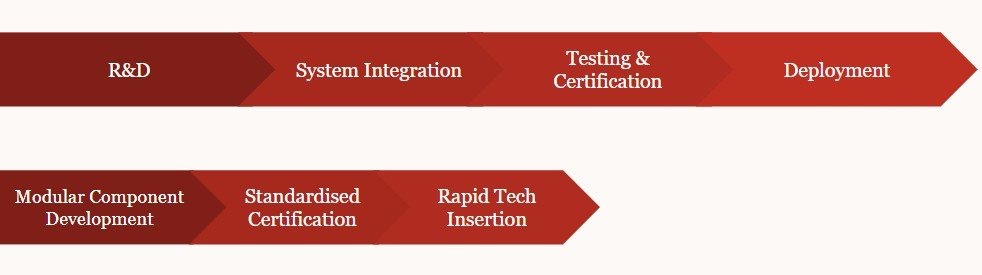
The result is a continental defence apparatus that functions with greater structural efficiency. This standardised approach allows private capital to fund specialised components without the delays typically associated with broad system overhauls, gradually modernising the overall industrial base, transitioning the sector away from legacy supply chains.
Hence, the old architecture of European defence has fallen but what is replacing it is vastly superior. The rusted monopolies of the past have been swept away and private equity seemingly stands as the unseen financial engine of the continent. Europe has realised that true security must be actively built and for the first time in a generation, they have the capital and the technology to do exactly that.
Footnotes
-
Bloomberg, Thales Agrees €3.9 Billion Deal to Acquire Exail Technologies (opens in a new tab), July 6, 2026.
-
Bloomberg, Fincantieri Speeds Subsea Buildout With Deals to Buy Four Firms (opens in a new tab), July 6, 2026.
-
Financial Times, The next frontier for defence companies is the deep blue sea (opens in a new tab), July 6, 2026; Advent International, Cobham Ultra, an Advent portfolio company, agrees to sell Ultra Maritime, a technology-led undersea warfare solutions provider, to Lockheed Martin (opens in a new tab), July 6, 2026. 2
-
European Council, EU Defence in Numbers (opens in a new tab), 2025 figures citing European Defence Agency data, July 17, 2026. 2
-
Aerospace Global News, Airbus and MTU plan hydrogen fuel-cell propulsion venture for future aircraft (opens in a new tab), July 8, 2026; Reuters, Canada taps Germany's TKMS for submarines ahead of NATO summit (opens in a new tab), July 6, 2026; AeroTime, Germany to buy Tomahawk cruise missiles after deal with US, Merz says (opens in a new tab), July 9, 2026.
-
Eustochos, The Militarisation of the Arctic: Power, Geometry, and the Return of Strategy (opens in a new tab), January 17, 2026.
-
PwC, EDIP explained: your guide to Europe’s new Defence Industrial Regulation (opens in a new tab), 2026.