
Every month governments, economists and businesses try to answer the same question: where is the economy heading next? Is GDP growth positive? Will interest rates rise? For decades, economists have depended on statistical models to forecast these variables. With the recent rise in the use of generative AI and machine learning, institutions have begun to adopt large language models (LLMs) and AI agents to analyse vast quantities of data in real time to predict future metrics and account for volatility. But does this mean AI can predict the economy better than economists?
The limits of traditional forecasting models
Traditionally, macroeconomic forecasting has relied primarily on econometric models. Structural Econometric Models (SEMs) are commonly used: the economic environment is described, a stochastic model is created, and assumptions about how different parts of the economy interact are built in.1 Time-series analysis, an extension of linear regression, is also used to identify patterns within historical data and project future outcomes.
However, real events have proven that these traditional models are not always reliable. Take the COVID-19 pandemic. The figure below shows UK monthly GDP against a simple pre-pandemic trend, estimated on 2016 to early 2020 data. Extended forward, that trend is roughly what a model trained only on the pre-pandemic economy would have expected. Actual output diverged from it sharply in 2020 and, years later, has still not returned to the old path.2
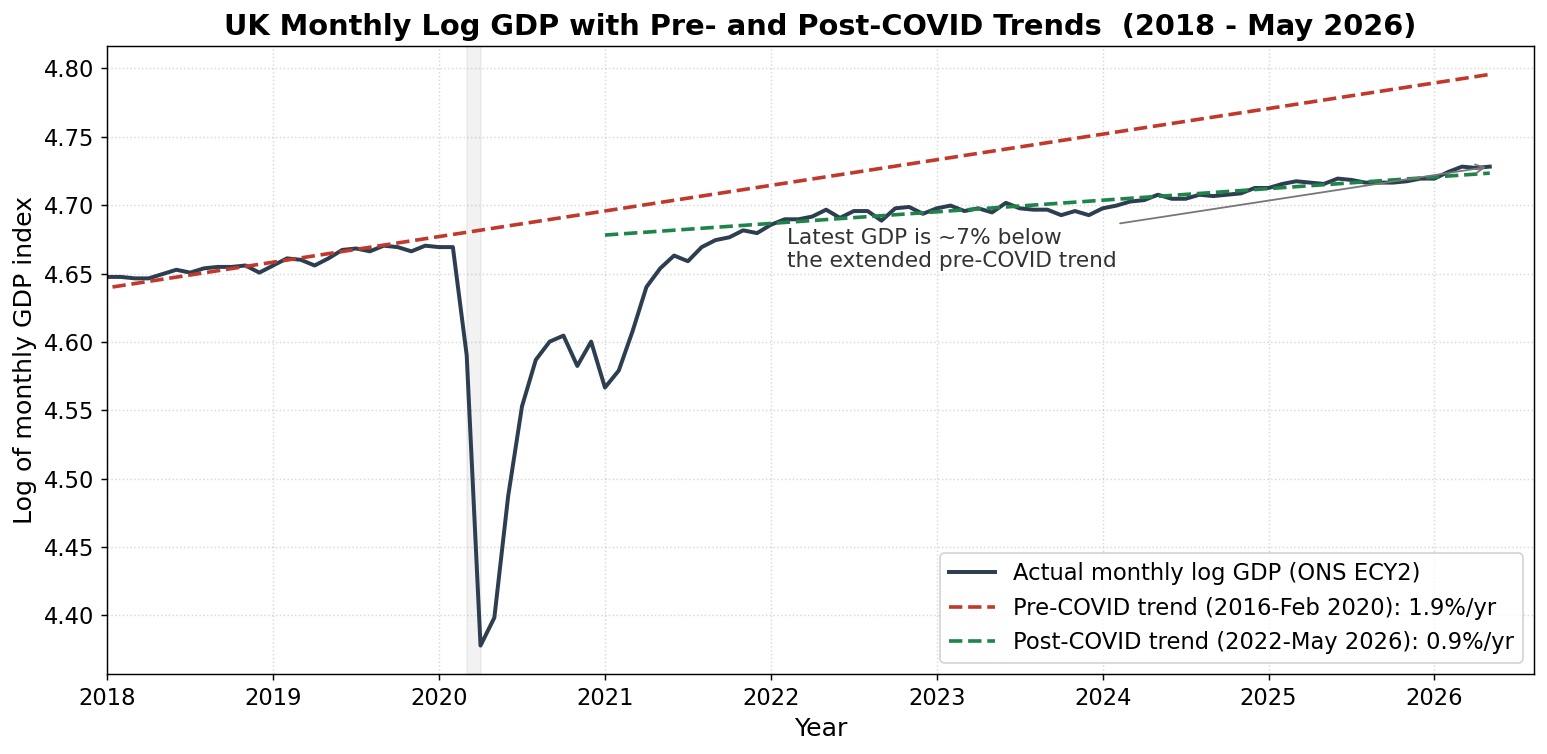
The pre-pandemic trend itself was not unreasonable. Given the steady growth of the preceding years, continued expansion was the most likely path. The sudden collapse in 2020 illustrates a key limitation of statistical forecasting: models cannot predict unprecedented external shocks that are absent from their training data. Economic relationships change over time; they are rarely constant. When econometric models are trained on steady GDP growth, they perform poorly once a pandemic or geopolitical shock fundamentally changes household behaviour or government policy. The chart shows a subtler failure too: even after the shock passed, growth settled onto a visibly shallower path, so a model calibrated to the old trend would have kept over-predicting for years.
If traditional models struggle because the economy changes faster than they can adapt, could artificial intelligence offer a better solution?
Where machine learning changes the picture
Machine learning is a subset of artificial intelligence in which models are trained on vast datasets to "learn" how to generate accurate inferences on their own.
These models can process thousands of variables simultaneously, including data sources that traditional econometric models were never designed to handle. Instead of specifying relationships manually, they learn them from the data. Advanced models can capture complex interactions that traditional econometric models miss. They can automatically detect threshold effects, for example, how a sudden increase in interest rates might cause no economic reaction until a critical "tipping point" is crossed, which then triggers an exponential drop in investment.
AI cannot predict unprecedented events before they occur. However, once a shock begins to unfold, machine learning models can often detect changes in economic activity far earlier than traditional official statistics. GDP figures are often released with a four- to eight-week lag, motivating the practice of nowcasting: using real-time information to estimate the current values of economic metrics before official releases. Take inflation: data such as online retailer prices, credit card transactions and web-scraped listings can all be analysed. If hundreds of retailers simultaneously raise prices online, an AI model may detect inflationary pressure before it ever appears in the official CPI.
The black box problem
But AI is not perfect. One of its greatest limitations is the so-called black box problem. This is the inability to understand how complex models arrive at their decisions. Lawsuits against UnitedHealth and Cigna allege that AI systems were used to recommend or automate the denial of medical claims, despite physicians believing that further treatment was medically necessary. Critics claim UnitedHealth's algorithm had a 90% error rate on appeal, with nine of ten appealed denials ultimately reversed.3 Although economic forecasting does not directly determine medical treatment, it increasingly influences investment decisions and government policy. If policymakers rely on opaque AI models, they face the same fundamental question raised by the healthcare lawsuits: can we trust a prediction if we cannot explain how it was produced? AI can be extremely useful, but when its reasoning cannot be understood, audited or challenged, mistakes become much harder to detect.
Humans and machines, not humans versus machines
We cannot forget how reliable economists were before technology developed so rapidly. Machine learning models are not automatically better than traditional models. In fact, humans win "Man vs. Machine" when institutional knowledge is vital, while the relative advantage of an AI analyst is stronger with large and transparent datasets. According to a study of stock return predictions, the combination of AI and human expertise produces the highest accuracy of all.4 AI is already improving the speed and scope of economic forecasting, particularly through real-time data analysis and pattern recognition. Yet forecasting is more than finding statistical relationships. Economic predictions require judgement, domain expertise and an understanding of how policy and human behaviour interact. Rather than replacing economists, AI is becoming one of their most powerful assets.
The future of economic forecasting is unclear, but as machine learning continues to improve, the most reliable predictions will come from economists who know how to work alongside AI.
Footnotes
-
Peter C. Reiss & Frank A. Wolak, Structural Econometric Modeling: Rationales and Examples from Industrial Organization (opens in a new tab), Handbook of Econometrics, Volume 6A, Chapter 64, 2007.
-
Jennifer L. Castle & David F. Hendry, Economics Observatory, Why Can Economic Forecasts Go Wrong? (opens in a new tab), 23rd June 2023.
-
HEALTH CARE un-covered, As UnitedHealth and Cigna Are Sued for AI-Based Claims Denials, Documents Suggest Major AI Expansion (opens in a new tab), 11th July 2024.
-
Sean Cao, Wei Jiang, Junbo L. Wang & Baozhong Yang, From Man vs. Machine to Man + Machine: The Art and AI of Stock Analyses (opens in a new tab), Journal of Financial Economics, Vol. 160, 2024.