
Why Newcastle?
While Newcastle's notorious nightlife wasn't built over one night, a considerable amount of its economic activity is generated during them. During the 1990s and early 2000s, Newcastle's nightlife gained enormous national visibility through newspapers and television. Coverage focused on excess drinking, which inadvertently marketed the city as a nightlife destination. The presence of Newcastle University and Northumbria University has helped sustain this reputation by providing a steady stream of consumers. With around 45,000 students in the city, Newcastle has a reliable demand base for pubs, bars and clubs throughout the academic year.1
Newcastle has also long offered a cheaper night out than London and other southern rivals. A red pint in The Five Swans, a Wetherspoon's in central Newcastle, costs £1.99, compared to a sobering £6 in The Montagu Pyke, a Wetherspoon's in Soho, central London: a red-ical price gap of 201.5%. The result is a city where affordability, geography and a large student population combine to create a comparative advantage in the market for nightlife.
One night stands out: Wednesday. While Newcastle's nightlife economy operates throughout the week, Wednesday Sports Night represents one of its largest and most predictable sources of demand. This article uses an original survey of Newcastle students to answer three questions: how much a typical Sports Night is worth, where that money goes, and why students keep spending it, week after week.
Sports Night: The Background
University sport has been organised nationally since the establishment of the Inter-Varsity Athletics Board in 1919, with British Universities and Colleges Sport (BUCS) becoming the governing body in 2008.2 Today, Wednesday is the principal day for BUCS competitions, with thousands of students representing their universities each week. The tradition of post-match socialising has since evolved into what is now widely known as "Sports Night". Every Wednesday, students migrate from the playing field to the city centre, creating a recurring market fuelled not by traditional advertising but by dense social networks and sporting traditions.
For readers who don't know Newcastle, a typical Sports Night moves through a few key places. It starts in student houses in Jesmond, a student-dominated suburb around a mile from the city centre, before moving to the pubs on Osborne Road, Jesmond's main strip, such as Blanc, Spy and Soho. From there, students head into the city centre to pre-club bars such as Pumphreys, Market Shaker and Flares, before finishing at Tup Tup Palace, a large city-centre nightclub that has become one of the principal destinations for Sports Night.
Data and Method
The figures in this article come from a Microsoft Forms survey that I designed and distributed to members of university sports societies. It received 106 responses from students across year groups and different sports societies.
Respondents reported how much they typically spend at each stage of a Wednesday night, and the figures below are the averages across all respondents. Costume spending is averaged across every respondent, although most of it is spent by freshers. Rollover spending on Thursday is reported separately and excluded from the £82.48 total.
The ticket figure needs one assumption. Tup Tup Palace releases tickets in tiers priced at £3, £4, £6 and £8, and the survey did not record which tier each respondent bought. I have therefore assumed tickets are evenly distributed across the four tiers, giving an average price of £5.25. This matters for the headline result later on: if everyone paid £3, the ratio of total spending to admission would be higher, and if everyone paid £8, it would be lower.
Because the survey went to sports society members, figures such as attendance rates describe that group rather than Newcastle students as a whole. Given that Sports Night is a sports society tradition, this is the group that matters most, but the figures should not be read as applying to every student in the city.
The Night Out
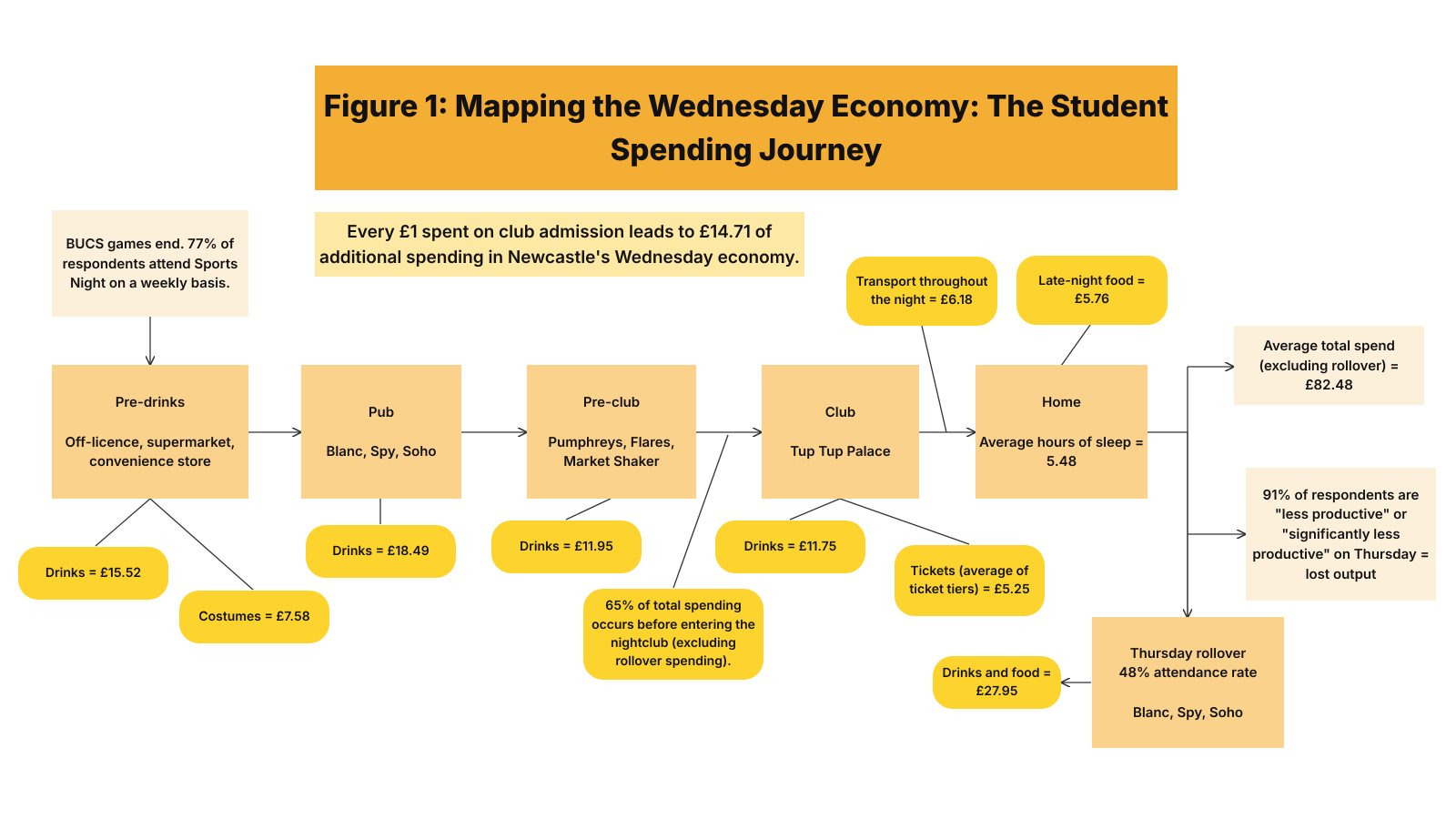
Figure 1 maps the full spending journey of a typical Sports Night, from pre-drinks through to Thursday rollover, and the chart below breaks down how much is spent at each stage.
Most Sports Night spending happens before the club
Sports Night in numbers
-
77% of respondents attend every week
-
£82.48 average spend per night, excluding rollover
-
5.48 hours of sleep on average afterwards
-
91% say they are less productive on Thursday
-
48% attend Thursday rollover at least occasionally, spending £27.95 on average
Pre-drinks
The night begins with pre-drinks (or "pre's" in student terminology), where students buy alcohol from supermarkets, off-licences and convenience stores. Respondents reported spending an average of £15.52 on pre-drinks each Wednesday. Pre-drinks are typically hosted in second- and third-year houses, where sports teams gather for drinking games. These socials often revolve around themes and fancy dress, and freshers (first-year students) are usually expected to dress up, which adds an average of £7.58 per respondent in costume spending before the first drink is even poured.
The Osborne Road pubs
Next, students migrate to the Osborne Road pubs. Respondents reported spending an average of £18.49 here, making the pubs the single largest spending category of the night. Students spend 57.4% more in the pubs than on drinks inside the nightclub.
Into town and the pre-club bars
From the pubs, students typically travel into the city centre by Uber, with average transport spending of £6.18 over the course of the night. They then arrive at pre-club bars such as Pumphreys, Market Shaker and Flares, where average spending is £11.95, helped along by offers such as Pumphreys' infamous three trebles for £10.
Tup Tup Palace
For many sports societies, the night ends at Tup Tup Palace. Respondents spend an average of £11.75 on drinks inside, on top of an average ticket price of £5.25. Taken together, the club accounts for £17.00 of the average night.
Home, food and sleep
Spending continues after the club closes, with an average of £5.76 on late-night food. Respondents then reported an average of just 5.48 hours of sleep, and 91% said they were either less productive or significantly less productive on Thursday.
Thursday rollover
For some, the night doesn't end on Wednesday at all. 48% of respondents reported attending rollover events at least occasionally, usually at the same Osborne Road pubs, and those who attend spend an average of £27.95. What students describe as "hair of the dog", economists might describe as another round of consumption.
The Analysis
Where the money goes
Every ticket bought for Sports Night comes with spending on drinks, transport, takeaway food and other complementary goods and services, meaning goods that are usually consumed together. Using the average spend of £82.48 and an average ticket price of £5.25, every £1 spent on club admission comes with approximately £14.71 of additional spending across Newcastle's Wednesday economy.
Despite being the destination of the night, Tup Tup Palace captures only 20.6% of total spending. The remaining 79.4% goes to pubs, supermarkets, transport providers, takeaways and other local businesses, and 65% is spent before students even reach the club. The Osborne Road pubs act as a channel that large volumes of demand funnel through on the way to the city centre, making them the largest financial beneficiaries of Sports Night. The nightclub may be the destination, but much of the economic value of Sports Night goes to the businesses operating around it.
This spending also matters for where it comes from. Much of what students spend is funded by student loans and family money from outside Newcastle, which makes it an injection of new money into the local economy rather than money simply moving around within it. Some of it leaks straight back out, as national and global companies such as Wetherspoon's and Uber send part of every pound they take outside the city. What remains is spent again by local businesses and their staff, which is where Sports Night's genuine multiplier effect on Newcastle's economy comes from.
Why students keep spending
By the time students reach the pre-club bars, they have consumed enough alcohol to challenge one of economics' most important assumptions: rational behaviour. As the night goes on, demand becomes increasingly price inelastic, meaning consumers become less sensitive to price changes. Consumers who would diligently compare prices in a supermarket at 11am become far less price sensitive at 11pm, which gives venues greater pricing power to raise prices without significantly reducing demand. Students also show present bias, placing greater weight on immediate rewards than on future consequences.3 The prospect of tomorrow's lecture, hangover or bank balance matters less than Pumphreys' three trebles for £10. As rationality falls, spending rises, and the relationship is intoxicatingly profitable.
The crowds at Tup Tup Palace are underpinned by powerful network effects, which Harvard Business School professor Feng Zhu defines as any situation where the value of a product, service or platform depends on how many people use it.4 Put simply, students attend because their teammates attend, and their teammates attend because everyone else is there. Sports societies therefore act as highly effective customer acquisition channels, delivering large numbers of consumers to venues at relatively little marketing cost.
Behavioural economics helps explain why these network effects persist. 27% of respondents attend at least partly due to FOMO or social pressure, which shows that the decision to go out is shaped not only by individual preferences and simple cost-benefit calculations, but also by the social incentives of being part of a team. For many students, the social cost of staying home may outweigh the financial cost of going out, which helps explain why attendance stays high despite the expense, the lack of sleep and the inevitable Thursday morning hangover. Students also display herd behaviour, choosing venues because their teammates and friends are going rather than judging quality or value for money for themselves.5 As a result, attendance becomes self-reinforcing: popular venues become more popular simply because they are expected to be busy, and students effectively market Sports Night to one another.
How venues price the night
These behavioural tendencies help explain the pricing strategies that Tup Tup Palace and competing venues use. Ticket releases are a form of second-degree price discrimination, where consumers self-select into different pricing tiers according to their willingness to pay. Early-bird buyers pay £3 for entry, while those who leave it later pay up to £8: a high price for procrastination. This serves two purposes. First, early discounts reduce uncertainty for the venue by giving advance information about likely attendance. Second, they create momentum around the event, signalling popularity and encouraging more people to buy tickets.
The social nature of Sports Night makes this strategy more effective. In a perfectly competitive market, consumers faced with rising prices would switch to a cheaper substitute. Sports Night, however, comes with strong network effects and behavioural switching costs. Once teammates have committed to a venue, many students are willing to pay higher prices simply to stay with the group, because they are not just buying admission, they are buying access to a shared social experience. Missing out is felt as a loss, and loss aversion means that loss can outweigh the extra £5 needed to attend.6 This helps explain why the move from £3 to £8 tickets meets relatively little resistance, and why students are less price sensitive than traditional economic models would predict.
Tup Tup Palace strengthens its position further through targeted promotion, offering selected sports societies complimentary bottles, queue-jump privileges and discounted entry. These incentives are aimed at influential societies and individuals, such as presidents, captains and social secretaries, whose attendance makes it much more likely the rest of the society will follow. When they are confirmed attendees, others are willing to pay more to be involved. A complimentary bottle may cost the venue relatively little, yet it can bring in dozens of additional customers and the spending that comes with them. In effect, sports societies operate less like ordinary customers and more like informal distribution networks, allowing Tup Tup Palace to convert social capital into financial capital.
The costs and trade-offs
Sports Night also comes with costs. Respondents' average of 5.48 hours of sleep is around 2.5 hours less than the commonly recommended eight hours, a sacrifice made in exchange for the social benefits of taking part. Research examining sleep deprivation across OECD economies estimated that insufficient sleep costs up to $680 billion a year through reduced productivity.7 Consistent with this, 91% of respondents reported being less productive on Thursday. While each student generates an average of £82.48 of economic activity on a Wednesday, they also pay for it through reduced study time, missed lectures and lower engagement with their degree. Sports Night is therefore a trade-off between enjoyment in the short run and academic performance and human capital in the long run.
However, traditional economic measures struggle to capture the value of social capital, despite it being one of the main things students are paying for. Through repeated participation, students strengthen friendships, integrate into their societies and build personal and professional networks. These benefits create positive externalities of their own: better team cohesion may improve sporting performance, and stronger interpersonal skills and wider networks may pay off long after university.
Conclusion
From BUCS to Bucks, Wednesday Sports Night is far more than a student tradition. It is a socially reinforced market generating an average of £82.48 of spending per participant each week, with every £1 spent on club admission accompanied by a further £14.71 across Newcastle's economy. Sustained by network effects, with 77% of respondents attending weekly, sports societies create a highly predictable source of demand for pubs, retailers, transport providers, nightclubs and takeaways. Although taking part comes at the cost of sleep and productivity, its enduring popularity suggests many students believe the social returns outweigh the costs. Ultimately, Sports Night shows how social capital can be turned into financial capital, converting friendships into footfall, footfall into spending, and spending into economic value. What begins as competition for BUCS points ends as competition for pounds, pints and market share.
Footnotes
-
Prospects, 7 most popular UK student cities (opens in a new tab), October 2025.
-
British Universities and Colleges Sport, Our History (opens in a new tab).
-
Quarterly Journal of Economics, Golden Eggs and Hyperbolic Discounting (opens in a new tab), 1st May 1997.
-
Harvard Business School Online, What Are Network Effects? (opens in a new tab), 22nd October 2026.
-
Quarterly Journal of Economics, A Simple Model of Herd Behavior (opens in a new tab), 1st August 1992.
-
Econometrica, Prospect Theory: An Analysis of Decision under Risk (opens in a new tab), March 1979.
-
RAND Europe, Why Sleep Matters: The Economic Costs of Insufficient Sleep (opens in a new tab), 30th November 2016.